Showing posts with label Vietnam Music. Show all posts

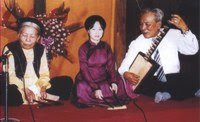
Xam singing - the unique traditional music in Vietnam

When the Xam singing stage appear on Hang Dao - Dong Xuan street walk - from the beginning of the April-2006, suddenly we see Xam still very charming.


Xam is street music. But why is it not fitted with a tail, but in combination with other Bo Ho(other name of Hoan Kiem lake) ? Some others call the "Xam station". Actually invoking different basis to call back but no other train station where they also want to run away anywhere from Bo Ho and some where come back also stopped at Bo Ho.

Why Xam singer not choose Hang Co station pier is also more crowded tramcar stations? Simply tramcar only up to a third prescription, but carry fewer guests than continuous trip so guests are always new. But trains do not go on continuously, moreover, is to ship it home or to the right destination. Therefore, electric wharf where money is more convenient than other places, so popular with rail mount gray. In the song gray, not about territory conventions, this is where the group sat himself said the other away. Between them has never contested seat fight song, because they are construed the phrase "At the same time director said."

Legend has it that, in the thirteenth century, Prince of Tran Quoc Dinh was stabbed by brother in forest green blindness, grab valuable gem to occupy the crown. In utter delirium, Dinh dream him was singing with a flock of fairies dance jubilantly ... Wake up, the prince knew the rural villagers wholeheartedly care. Through the tribulation and dream recall, Dinh was close at hand manipulated a musical instrument with long bamboo tube with soft rod to correct volume, rope spin by tree cover and stick to turn on, knock to music. He also compiled all the poems to music, including feelings of his life, bring joy to every family, every home, hand mouth now sing everywhere, from the river, markets, communal house yard  ... reputation of the blind singer until imperial city,  the King invited in the palace, know that Prince missing year ... From there, Dinh strove to teach singing to all men, especially those blind, just for fun is life, is both a living business...


The instrument in art Xam music

So when Xam was born ? Researchers have said that Xam was born before Cheo singing, was one of many sources contributing constitutes cheo singing. Or Xam only a copy of the clumsy of Cheo singing in conditions and circumstances in a very limited class persons with disabilities, or the relationship is inevitable no gut clearance between the two forms denied, by the artist Xam and Cheo same popular song, while Tuong on type of fight song, Tru singing is poem song. The research Xam talk: Xam singing is a form appeared in Hanoi in the late nineteenth century, the twentieth century. Initially only Xam in Hanoi, then "spills" out to get the Xam tones of Ninh Binh, Nam Dinh, Hung Yen ... Xam are a lot, but there are seven items featured: Xam market, Riem Hue, Ba bac nhip bang, Phon Hue, who singing with anybody and Xam tramcar stations  ... All Xam song about Hanoi often target destination, home to introduce to people in the village about urban and "bootlick" urban people, where their stretch one's back to earn living daily .

The year 30 of the previous century, in a Xam neighborhood in An Duong bank. The reason is so named because the roof about 10 neighbors have all those sing Xam. During the day they go to sing, I sleep here. Neighbors exist until 1954, then each people place. The number of people sing Xam that crowded in the French colonial period and the early years of the war against France. That is the most jubilantly in 1954. After the Republic of Vietnam was born, Xam also was "current affairs." Such movement in response to popular academic, Xam artists wrote the song "Cast out enemy ignorance". After the Geneva agreement, the State mobilize many Xam groups, appoint people to write songs and performed in the northern coastal areas to combat movement moved to South by French colonists entice. Some three dozen artists singing Xam in Hai Duong, Ninh Binh, Nam Dinh, Bac Giang, Hanoi ... participated in this campaign. Thanh Tinh writers assigned a group of 23 people blinds went Bui Chu, Phat Diem to sing on purpose. The peace restore in the North, at Bo Ho train stations still pretty much blind singing Xam, have a couple dwarfs sing very well and they make a living here until the USA led bombing of Hanoi affair another go unidentified. In the years of 1970, this art form and then go gradually fade into obscurity. Since then the people sing Xam didn't practicse, seemingly singing Xam was lost.

When the stage singing Xam appear on Hang Dao street walk - from the beginning of the month 4-2006 Dong Xuan, suddenly we see gray and salty but still very charming. Thao Giang musicians, head of the folk music program "36 streets of Hanoi" and who is the collection, restoration of Xam that the art of singing. He said : how to trade, the shop can change but the soul of the song remains in mind when they hear Xam. In order for this program, the "Hanoi Xam group" has collected about 20 tones. Apart from what is popular poem by Nguyen Khuyen, A Nam Tran Tuan Khai, Nguyen Binh such as: Muc ha vo nhan, Anh khoa, Missed step sideways, bright moon the tea gardens, Xam tramcar...

That's a good signal for the future of xam in the street culture of Thang Long - Hanoi. And sure will not be desert that period ...

The famous Hanoi autumn melody - part 1

Hanoi autumn with simple beauty, passionate made deep emotions in poetry and conquer generations each attached to the capital.

The famous Hanoi autumn melody - part 1
Vietnamese girl with oriental robe

"Hanoi night wind change direction" (Vietnamese meaning: Hà nội đêm trở gió ) with lyrical melodies intimate feelings for the capital has become a timeless music of Vietnamese music. Trong Dai composers wrote songs in temporarily years away from home to study in Russia. This song is the author's journey to find the beautiful memories from beloved childhood days with Hanoi.

It was an autumn afternoon "wind on wide on the streets, golden pink light bright smiles", which echoes the voice announcement of the peddled wares on the street, that is "clothes of pupil green tamarind trees " and especially "Lonely dracontomelum fall outside the deserted alley" - a poetic image impression for anyone who ever attached with Hanoi. This song is a piece of faded memories can not be taken away with pupils by this song through the voice of the wind My Linh singer, once considered the students in best favorites in the 1990.

Vietnamese lyric

"Hà nội ơi tươi xanh màu áo học trò
Những con đường thân quen còn đó
Tiếng rao vang đâu đây nghe động trời đêm
Hồng Hà ơi buồm ai khe khẽ thuyền về
Cành me thì thầm gục đầu vào dĩ vãng
Tiếng ve kêu râm ran suốt đêm hè
Giọng dân ca sao gợi nhắc hồ Gươm
Hà nội ơi xanh xanh liễu rủ mặt hồ Gươm
Cô đơn sấu rụng ngoài ngõ vắng
Con sóng nào vẫn vỗ về vào đam mê Hà nội ơi ... Hà nội ơi
Ta nhớ không quên những tháng năm qua
Một nét riêng tư gợi nhắc cho ai là nhắc đến những kỷ niệm đã qua
Hà nội ơi nhớ về mùa thu tháng mười
Áo học trò xanh những hàng me
Hà nội ơi ta nhớ không quên Hà nội ơi trong trái tim ta
Chiều mùa thu gió về rộng trên phố phường
Nắng vàng hồng tươi những nụ cười
Hà nội ơi ta nhớ không quên
Hà nội ơi trong trái tim ta....."

English lyric:

" Hey Hanoi bright green shirt of pupil
The familiar path remain
Echoes the voice announcement of the peddled wares make the startling night 
Hey Hong Ha(other name Red river) who sails on the boat return softly
Branch of tamarind tree whisper collapse head on past
Voice of the cicada rumble all days of summer 
Fork song voice reminded to Ho Guom lake
Hey Hanoi green- green drooping willow Ho Guom surface
Lonely dracontomelum fall  outside the deserted alley
Waves which remain to soothe passions hey Hanoi ... hey Hanoi 
I remember not forget the time past
A private character who is reminded to refer to past memories
Hey Hanoi remember about the autumn in October
Uniform of students are green tamarind trees
Hey Hanoi I can not forget - Hey Hanoi  in your hearts
Autumn afternoon wind on the wide streets
Golden pink light bright smiles
Hey Hanoi I remember not forget
Hey Hanoi in your hearts ...."

The famous Hanoi autumn melody - part 2

"... August-  the autumn, have leaf fall the gold ?
From people leave away, silently remember
Are you the Hanoi autumn?
Hardships of life, I also try to find
Are you ancient autumn ?..."

The famous Hanoi autumn melody - part 2

The tone of sweet and romantic of "Are you the Hanoi autumn" make to devote so many generations of Vietnamese lovers music. Although not born and grown up in Hanoi, but the sentiment comes from the bottom of my heart for this land, Tran Quang Loc composer  and To Nhu Chau poet has created a immortal song of autumn. Unknown author writing in time, also not clear ever since, the song is "Are you the Hanoi autumn" has become familiar with Vietnam and music lovers often echoed each autumn come.

Many famous voices expressing each song, but probably left the deepest impression in the heart of the audience is full of strong vocals and inspiring of Thu Phuong singer. In the quiet calm on autumn time, sure anyone would feel the vibration when I ran back in the old feeling of concern musician and poet singing in a sentence: "August-  the autumn, have leaf fall the gold ? ".

Vietnamese lyric

Tháng tám mùa thu, lá rơi vàng chưa nhỉ
Từ độ người đi thương nhớ âm thầm
Có phải em là mùa thu Hà Nội
Tuổi phong sương ta cũng gắng đi tìm
Có phải em mùa thu xưa

Có bóng mùa thu thức ta lòng son muộn
Một ngày về xuôi chân ghé Thăng Long buồn
Có phải em là mùa thu Hà Nội
Ngày sang thu anh lót lá em nằm
Bên trời xa sương tóc bay


Thôi thì có em đời ta hy vọng
Thôi thì có em sương khói môi mềm
Có phải em là mùa thu Hà Nội
Nghe đâu đây lá úa và mi xanh
Nghe đâu đây hồn Trưng Vương sông Hát

Có chắc mùa thu lá rơi vàng tiếng gọi
Lệ mừng gặp nhau xôn xao phím dương cầm
Có phải em là mùa thu Hà Nội
Nghìn năm sau ta níu bóng quay về
Ơi mùa thu của ước mơ 

English lyric

August-  the autumn, have leaf fall the gold ?
From people leave away, silently remember
Are you the Hanoi autumn?
Hardships of life, I also try to find
Are you ancient autumn ?..."

The shadow of autumn get up late faithfulness
A day return lowland  visiting sad Thang Long
Are you a autumn of Hanoi ?
Days to autumn I  line leaf for you lie
On the far sky- dew hair fly

Only you that make my life hope
Only you that smog  make soft lips
Are you a Hanoi autumn ?
Listening anywhere dead leaves and green eyelash
Listening anywhere the Trung Vuong soul river sing

There are certain golden autumn leaves fall call
Happy tear met together tumult piano keys
Are you a Hanoi autumn?
Thousand years later I grab shadow back
Oh autumn of dream

The famous Hanoi autumn melody - part 3

"... The autumn of Hanoi, yellow Com Nguoi trees
Terminalia catappa tree are red-leaf, located adjacent to each other
Ancient city ancient house, dark brown roof tiles
Hanoi autumn, autumn in Hanoi ... "
 
Cay bang-The famous Hanoi autumn melody - part 3


 <--- Terminalia catappa tree with red leaf when autumn

As one of the most famous songs of the Hanoi by composer Trinh Cong Son, "Remember the autumn of Hanoi" to give the listener a sense of dazed, fret. Hanoi autumn with the yellow color ofthe green of Com Vong created a stunning collection of paintings that have been nowhere. The picture that makes the listener feel a sharp collection of Hanoi in a very gentle and charming. Hanoi autumn brings a tormenting nostalgia that even the author can not be named. Indeed late composer Trinh Cong Son wrote melodies "Remember the autumn of Hanoi" by heart all the love and the quiver full of poetic beauty of nature's autumn here. Singer Hong Nhung is expressed most successful song
the Com Nguoi trees, the red color leaves of Terminalia catappa tree, dark brown color of old houses,

Vietnamese lyric:

Hà Nội mùa thu, cây cơm nguội vàng, cây bàng lá đỏ,
Nằm kề bên nhau, phố xưa nhà cổ, mái ngói thâm nâu.

Hà Nội mùa thu, mùa thu Hà Nội,

Mùa hoa sữa về thơm từng ngọn gió,
Mùa cốm xanh về, thơm bàn tay nhỏ,
Cốm sữa vỉa hè, thơm bước chân qua.

Hồ Tây chiều thu, mặt nước vàng lay bờ xa mời gọi.

Màu sương thương nhớ, bầy sâm cầm nhỏ vỗ cánh mặt trời.

Hà Nội mùa thu đi giữa mọi người,

Lòng như thầm hỏi, tôi đang nhớ ai,
Sẽ có một ngày trời thu Hà Nội trả lời cho tôi,
Sẽ có một ngày từng con đường nhỏ trả lời cho tôi.

Hà Nội mùa thu, mùa thu Hà Nội, nhớ đến một người ...

Để nhớ mọi người.

Cay Com Nguoi-The famous Hanoi autumn melody - part 3
Com Nguoi tree

English lyric:

Hanoi autumn go between people,

Heart in a question, I miss someone,
There will be a day Hanoi autumn reply for me,
There will be a day each small way answer for me.

Hanoi autumn, autumn in Hanoi, remembered  a person...

To remember everyone.

(1)Com Nguoi tree: Cold rice tree with the scientific name is Celtis sinensis Pers belong  family name hemp. This is the only tree species have yellow leaf in Hanoi autumn. Because pulp  tastes like cold rice and should be named the Com Nguoi tree(cold rice tree).


The famous Hanoi autumn melody - part 4

" .. The old memories still somewhere
The mutual friends are common

The small ways
Milk flower is still sweet the city every night
Maybe you forget me

Maybe... you forget me "


First appeared in the film "Hanoi - the season bird make nest" by female director Duc Hoan in 1978, "Milk Flower" has quickly found its own place in musical life. Lyrics talk about the separation of lovers, on expectations that the lover of a young girl, but every sentence sing "Milk flower is still sweet the city every night " resound, the audience often think of the fall of Hanoi by only Hanoi have a passionate scent of flowers milk - a feature that has been nowhere. Therefore, "Milk Flower " by musician Hong Dang is living forever in subconscious of  Vietnamese lovers music as one of the best song on the fall of Hanoi.
Vietnamese lyric

" Em vẫn từng đợi anh
Như hoa từng đợi nắng
Như gió tìm rặng phi lao
Như trời cao mong mây trắng
Em vẫn từng đợi anh 
Trên những chặng đường quen
Tiếng hát ai xao động
Thoáng mùi hoa êm đềm
Kỷ niệm ngày xưa vẫn còn đâu đó
Những bạn bè chung
Những con đường nhỏ
Hoa sữa vẫn ngọt ngào đầu phố đêm đêm
Có lẽ nào anh lại quên em
Có lẽ nào... anh lại quên em"

English lyric

" I have been waiting for you
As the flowers have been waiting the sun
As the wind look forward casuarina
As high sky hope white clouds
I still had to wait for you
On the familiar ways
The sound of you make to agitate
Transient fragrance from past year
The old memories still somewhere
The mutual friends are common
The small ways
Milk flower is still sweet the city every night
Maybe you forget me
Maybe ... you forget me "

Please tell Thanh Lam singer present "Flower milk" by Hong Dang composer:

The famous Hanoi autumn melody - part 5

"... Hanoi in the eyes of someone, how sad and fun in street corner
Hear the bell the afternoon calling ...
Hanoi in the your eyes or sound of fall autumn leaves 
And you came to me one afternoon, Hanoi afternoon ... "

The famous Hanoi autumn melody - part 5

The famous love-song  "Hanoi's afternoon" by Vu Quang Trung musician gave the audience the sweet taste of love with the image of gold falling leaves filled with romance. Fall awaken the desire love of every human, which makes the heart in the same situation harmony with rhythm. Nothing can describe the beauty of Hanoi's autumn afternoon, when the gentle rays shine through the last day of each corner with the afternoon bell ringing. "Hanoi's Afternoon" was born in 1993, when Vu Quang Trung musicians was very young and he was recommend each word with romantic soul of a Ha Thanh guy. Great tunes that have been and will continue to bring passionate for the fall of Hanoi and for lovers.

Vietnamese lyric:

Hà Nội trong mắt ai, bao buồn vui góc phố em
Nghe tiếng chuông ban chiều gọi ...
Hà Nội trong mắt em, hay mùa thu tiếng lá rơi
Và em đến với tôi một chiều, chiều Hà Nội
Ngày lại ngày góc phố, anh trông tôi bước đi
Từng giọt nắng hát ca, hòa nhịp trái tim
*
Hà Nội trong mắt ai, bao buồn vui góc phố em
Nghe tiếng chuông ban chiều gọi ...
Hà Nội trong mắt em, hay mùa thu tiếng lá rơi
Chiều hôm đó đến với tôi một chiều, chiều Hà Nội
Ngày lại ngày góc phố, tôi lang thang bước đi
Còn đâu nữa tiếng hát ca ngày nào với anh

**
Anh xa em, lá thu rơi, ngập đường ngập phố
Anh xa em, đường phố như say, dòng người đó đây
Anh xa em, để tiếng chuông khua lạnh lùng thành
Đừng xa em, đến bên em, trọn đời hỡi anh

English lyric:

Hanoi in the eyes of someone, how sad and fun in street corner
Hear the bell the afternoon calling ...
Hanoi in the your eyes or sound of fall autumn leaves
And you came to me one afternoon, Hanoi afternoon
Day after day street corner, he look me walked 
Every drop of sunshine singing, heart rhythm
*
Hanoi in the eyes of someone, how sad and fun in street corner
Hear the bell the afternoon calling ...
Hanoi in the your eyes or sound of fall autumn leaves
And you came to me one afternoon, Hanoi afternoon
Street corner day after day, I wandered step
All gone every day singing songs with him

**
You're far away from me, fall autumn leaves, flooded road flooded streets
You're far away from me, street such as drunken, the line person everywhere
You're far away from me, for the sound of bell beat a cold
Do not leave me, come with me, all life my dear.

The song with the sound Tam ca Ao Trang.

Quan Ho Bac Ninh - The traditional vietnamese music

For the Bac Ninh people, festivals not only allow them to highlight their own village's specialties, such as ceramics, folk painting, wrestling, kite parades, or bird contest, among a great many other things, but also their common prized heritage, the quan ho singing tradition.
From the past till now…
Ca quan ho, also called quan ho Bac Ninh singing, originated around the 13th century, and has traditionally been associated with the spring festivals that follow the celebration of the Vietnamese New Year. According to the tradition, only young people used to sing quan ho songs, as the major body of song texts centers on the subject of love and sentimental desire among young adults. Nowadays, many elderly singers participate in the singing as well in response to the quan ho movement initiated by the provincial government. Originally, quan ho singing were exchange songs between two mandarins' families. Gradually, it spread out and became popular among the northern people. Groups were formed just for singing, and many marriages were formed at these get-together. After centuries, it became the most significant Vietnamese folk-song type.
Characteristics.
Unlike the simple lullabies, which were inspired by daily works, quan ho was always searching for new content and new reforms. Virtually, all songs heard in festivals express personal subject like addressing the beautiful nature and the satisfaction after harvesting crops together. Love in quan ho is not sad and pessimistic as it is in lullabies (ru) or in calls (hò). On the contrary, the tune of this type is rich in tunes and rhythms because it received all the influences of lullabies, poem recitation, etc.
There are four major airs in quan ho singing:
  • Giọng sổng (transistor air)
  • Giọng vặt (diverse air)
  • Giọng hãm (recitative air)
  • Giọng bỉ (tunes borrowed from other sources)
The most popular quan ho songs, "qua cau gio bay", "treo len quan doc" (also known as "ly cay da"), "se chi luon kim", were sung in Giọng vặt. (transistor air)
If you did listen or watch a quan ho performance, you will see that it is an antiphonal singing tradition in which men and women take turns singing in a challenge-and-response fashion drawing on a known repertoire of melodies. In general, an initial "challenge phrase" (câu ra) is sung by a pair of female singers, followed by a "matching phrase" (câu đối) from the men, which repeat the melody of the challenge phrase. Once the order is reversed, the men will issue their own challenge phrase with a different melody.
One of the quan ho features that have endured through time is the proper verbal and poetic introduction to every tune. Quan ho singers are not only appreciated for their singing ability, but also for their skill in leaving an impression of their gracefulness and literary adeptness on the audience. Usually, one of the singers will say something to praise the opposing pair and express how fortunate her/his pair has been to be allowed to sing with them before reciting the verses of the song. Not only provides listeners with the basic content of the song, the rhetoric used in the introduction contribute to create the impression of a theatrical act.
The singers also imitated the musical sound, the sound of rice grinding, crying as well as replying in the tunes that their opposing pair had used. The singing ends with songs in the farewell category- a feature that has never been changed as a sense of a completion.
Instrumental accompaniment is welcomed by quan ho singers in some villages. The mono chord is the most common instrument, followed by the bamboo flute and the 36-stringed hammered dulcimer.
Trying to make cultural sense of the quan ho tradition as it is practiced today is not an easy task. Quant ho singing has undergone several changes with regard both to its context and content as its practitioners continue to search for ways to put the puzzle together, while realizing that missing pieces may never be found. Yet, the Bac Ninh locals believe that quan ho singing has always been the window through which outside people can see who they really are- the director of the quan ho troupe maintains.
If you want to hear of them directly, you can of Lim on 13 January every year according to lunar calendar in Tien Du district, Bac Ninh province. With popular games such as champion, wrestling, chess struggle, enough money, and weaving, cooking rice.
Lim of the Association is a heaven of sound, poetry and music space to the thought of fermentation. The new seven new clothes, the three important hats, fringe hanging at both side of a connical hat,silk camisole range of gravel, composed of six cells, turban, shirt pairs of Gam ... as containing all the hidden spring of life of people and create things. How's the game of their regional Lim also is a unique game, each gesture has to communicate it in a shade higher culture. The
Lim always leave in the heart of what a beautiful area lam. Cac old man Lim, Lim said that Vietnam is still conservation of Lim's past, but alternating the mark of cultural market. Lim who still sing them on the hills and under the boat Lim, but singing with microphone through broadcaster. Space is no longer grace the "cramped" in a limited space for both the song galaxy, all of heaven and hear the spring.
Source: Vietnam- beauty and some pages


Cheo, a popular traditional music performance


There’s a folk verse in Vietnam that tells about a lazy guy who does not want to do anything but could not resist the attraction of a Cheo play, which has played a very important role in Vietnamese cultural life for a long time and is considered the oldest and most popular folk music performance in Vietnam.
When did the Cheo appear?
Cheo is believed to have originated in the 11th century, and has its roots in village festivals in the Red River Delta.
After crops harvest, the farmers hold the festivals which include a series of activities such as plays, Cheo singing, etc. to exchange the information as well as to make new relationships. Since then, many national Cheo repertoires which are considered treasures of the traditional stage are created, expamples are Truong Vien, Kim Nhan, Luu Binh - Duong Le and Quan Am Thi Kinh…
Performance
Like many ancient performance arts, Cheo is an oral one with stories composed by anonymous author-performers and orally “passed on” to fellow performers. In this folk art performance, stories which can be legends, poetry, history or even daily life are the most important, “whenever there are stories, we have Cheo”.
Also, brought into the play are acrobatic scenes and magic. Cheo tells tales of chiefs, heroes and lovely maidens and offers an eclectic mix of romance, tragedy and comedy. These stories are performed by folk songs with pantomime, instrumental music and dances, combined with instructive or interpretative sketches.
Beside the stories, the characters are the soul of a play. Like Tuong, Cheo

Cheo buffoon
uses standard stock characters -usually a hero, a heroine and a clown- who are instantly recognizable to the audience. Cheo stories may sometimes be romantic or tragic but the clown or buffoon always comment on the action in an amusing or satirical way as well as to mock pompous, ridiculous or dishonest characters. Providing a link between the performers and the audience, he shoots shafts of satire at evil-doers, such as ignorant witchdoctors, greedy landlords, or arrogant mandarins. A couple of buffoons may appear on stage, for instance, the master in a flowing gown and his servant in a short coat and carrying a stick, each speaking the language and behaving in the ways of his class. The buffoon might perform right at the initial scene of a play, carrying a torch or a megaphone and provoking wild laughter of the audience. The clowns present a comic portrayal of social life, with ridiculous, satirical words and gestures, and reduce the audience to tears of laughter.
A Cheo play can not be complete without stage. The play could be put on the stage of a large theatre, but also be performed successfully on one or two bed mats spread in the middle of a communal house. The Cheo drum was traditionally used like a church bell with magical sounds. Upon hearing, villagers cannot resist coming to see the play. The costumes, make-up and gestures are very simple and base on each character of the play.
At present, Cheo is an integral part of Vietnamese theatre and attract not only people in the countryside and in towns but the foreign spectators as well.
Some intersting Cheo:


Source: VietNam Beauty and Wikipedia

Ca Tru: A Popular and Traditional Musical Art Form

Ca Tru
Ca Tru - an impromptu performance art which has a somewhat academic character - has been around for a thousand years. If one appreciates Ca Tru one almost certainly appreciates poetry and music. Ca Tru is also known as Hat Nha Tro (singing or dancing with humor), Hat Thuong (singing for king or mandarins), Hat Cua Quyen (singing in royal palaces), Hat Cua Dinh (singing for religious rituals) and Hat A Dao (the name of a famous songstress during the Ly dynasty). During the time of French administration, Ca Tru went into decline. Nowadays, it is being revived and promoted as a popular art form.

When did Ca Tru first appear?

One can find dan day (a musical instrument that accompanies Ca Tru singing) carved in stone in 16th century temples and pagodas in northern Vietnam: the Lo Hanh Temple in Hiep Hoa, Bac Giang, the Hoang Xa Temple in Ung Hoa, Ha Tay and the Tam Lang Temple in Can Loc, Ha Tinh. The earliest known written mention of Ca Tru is in Dr. Le Duc Mao's (1462-1529) book 'Le toc gia pha' (written prior to 1505) in the chapter 'Dai nghi bat giap thuong dao giai van'. Ca Tru is song that combines literature and music and it was popular for centuries in Vietnam's ancient capital city of Thang Long. From there, Ca Tru spread to other parts of the country. Ca Tru was a Vietnamese cultural practice and spiritual food for people in both royal palaces and the countryside. Ca Tru is a distinctive form of performance art that has both academic and popular character.

Musical instruments in Ca Tru: The co phach, dan day and trong chau.

Co phach: The instrument can be divided into three segments. The ban phach part is made of bamboo or wood. A singer uses two wooden sticks called phach cai or phach con to strike the bamboo or wooden piece to create a sound called phach. The phach sound keeps time for the singer and is in fact 'another voice'.

Dan day: This musical instrument is used only for Ca Tru singing. It has a rectangle or trapezoid-shaped body. The face is of a better kind of wood and the long neck has 10-11 frets. It has three strings that are made of silk and a dan day player is called a kep. The sound of the dan day, deep and profound, combines with the clear and sharp phach sound to create a musical contrast that is unique. The dan day is plucked with a piece of plastic or bamboo.
Trong chau: The trong chau that's used with Ca Tru is different in size and shape from the drum used in Tuong singing (a kind of Vietnamese classical drama), and it's beaten differently. It is the same drum that's used with Cheo singing but with Ca Tru it's beaten in an entirely different manner. The drumstick is made of wood and is longer than most others and the drummer expresses himself when beating the drum, encouraging the singer.

These three instruments, the dan day, the co phach and the trong chau, are inseparable. A subordinate instrument, the drum serves as a bridge between the performer and audience. The harmony that comes from the combination of the dan day, the co phach and the human voice makes the performance unique.

Generally, Ca Tru as a high art form is unique to Vietnam and is a valuable part of Vietnam's musical legacy and culture.


Listen to "Hello Vietnam" by Pham Quynh Anh

Now, listen to a beautiful song, named "Hello Vietnam"
Written: Marc Lavoine
Artist: Pham Quynh Anh


Lyric:

Tell me all about this name, that is difficult to say.
It was given me the day I was born.

Want to know about the stories of the empire of old.
My eyes say more of me than what you dare to say.

All I know of you is all the sights of war.
A film by Coppola, the helicopter's roar.

One day I'll touch your soil.
One day I'll finally know my soul.
One day I'll come to you.
To say hello... Vietnam.

Tell me all about my colour, my hair and my little feet
That have carried me every mile of the way.

Want to see your house, your streets. Show me all I do not know.
Wooden sampans, floating markets, light of gold.

All I know of you is the sights of war.
A film by Coppola, the helicopter's roar.

One day I'll touch your soil.
One day I'll finally know my soul.
One day I'll come to you.
To say hello... Vietnam.

And Buddha’s made of stone watch over me
My dreams they lead me through the fields of rice
In prayer, in the light…I see my kin
I touch my tree, my roots,my begin

One day I'll touch your soil.
One day I'll finally know my soul.
One day I'll come to you.
To say hello... Vietnam.

One day I’ll walk your soil
One day I’ll finally know my soul
One day I’ll come to you
To say hello…Vietnam
To say xin chào… Vietnam
 

Copyright © 2010 Welcome To Vietnam

Designed by Tony Tran